
Showing posts with label Budgeted Hourly Cost Rates. Show all posts

Friday, November 22, 2013

10 Ways to Financially Improve Your Printing Organization


Financial performance is a major concern of all organizations, whether you’re a commercial, packaging, digital, large format, or in-plant printing operation. Here are 10 ways you can improve the financial performance of your organization.

1. Improve Administrative Processes
Implement lean principles in your administrative areas to eliminate unnecessary and redundant non-value-added activities, steps, and handoffs in your sales, estimating, order entry, purchasing, invoicing, and accounting workflow.  Put a team together to define the steps required to get jobs through your administrative processes and design a more efficient "Lean" workflow.

2. Implement Industry Best Practices
Best practices are proven methods in which printing organizations have achieved top performance and serve as goals for other companies that are striving for excellence. Why reinvent the wheel? Improve your financial performance by adapting these accepted best practices to your specific needs.

3. Speed Up Throughput And Delivery
Write up orders accurately and effectively, and then use the quickest means available to produce and deliver products to customers. Unnecessary delays can add days or weeks to customer payments. You must pay out considerable costs in paper, wages, and other expenses to produce orders, so you want to get reimbursed as soon as possible.

4. Leverage Technology
The proper use of technology will improve the synergy of your organization and help it run more efficiently and effectively. An integrated management information system (MIS) like Avanti, EFI Monarch, EPMS, ePace, Radius, or Printers Software is a critical tool for managing and operating a financially sound printing organization. A typical MIS incudes estimating, order entry, inventory management, shop floor data collection, scheduling, job costing, and accounting. Implementing an ecommerce solution can eliminate time and costs associated with processing orders, speed your order to cash cycle, minimize inventory, and enhance relationships among customers and suppliers.

5. Keep A Tight Control On Inventory
Paper accounts for approximately 1/3 of your costs, so less cash tied up in inventory generally means better cash flow. While some suppliers offer deeper discounts on volume purchases, if inventory sits on the floor too long, it ties up money that could be put to better use elsewhere. Implement Just-in-time (JIT) inventory practices to reduce in-process inventory. You should not have items sitting in your inventory if it can be replenished before a job goes to press.

6. Review and Reduce Expenses
Take a hard look at all of your expenses. Consider ways to decrease operating costs, but be careful not to cut costs that could impede performance or profits. Reduce production expenses by scheduling better, reconfiguring work shifts, improving job planning, and eliminating spoilage. If you haven't already done so, implement Lean Office and Lean Manufacturing principles.

7. Know Your True Costs
Having a clear understanding of your costs is essential for producing accurate estimates, pricing orders, measuring job costs and profitability, and generating accurate accounting reports. Good job costing and shop floor data collection software can help to make sure that all of your labor and material costs are fully accounted for and absorbed in your estimating cost rates and pricing.

8. Invoice Customers Promptly
A customer cannot pay an invoice until they received it, so the faster you get the invoice to the customer, the faster you’ll get paid. When possible, send an invoice within 1 to 2 days after the order has shipped. A best practice is to establish the invoice amount when the order arrives and as the customer requests changes. The only exception is billable overs and shipping charges. Many companies are expediting the invoicing process by sending PDF invoices to customers using email.

9. Measure Your Performance
If you don’t measure it, you can’t improve it. If you don’t measure it, you can’t manage it. Time after time studies have found a strong correlation between a company's financial performance and effective goal setting. There are various tools for measuring performance including Performance Benchmarks, Key Performance Indicators (KPI’s), Balance Score Cards (BSC), and dashboards. Metrics can assess the health of your organization’s financial, production, cost, quality, and customer service performance.

10. Utilize Your Employees  Better
The need to effectively leverage the skills of employees is critical to improving your financial performance. You may have some people that have evolved into the wrong position over time. Or employees that are overloaded with work while others do not have enough to keep them busy. Take a close look at the skill set and workloads of your staff. Make sure employees are in the position that is best leveraging their capabilities.

If you're interested in learning how Profectus Printing Industry Business Consultants can improve your organization, contact Profectus for a FREE phone consultation at 1-888-868-8662. Or visit our website: www.profectus.com


Cost Rates Advisor Budgeted Hourly Rates Software


Monday, June 3, 2013

An Easier Way To Establish Equipment Budgeted Hourly Cost Rates

Many of our subscribers have been asking for an easier way to calculate and update their equipment budgeted hourly cost rates. After all, the industry best practice is to update BHRs at least annually.
 
For years our consultancy has used software or spreadsheets to calculate BHRs for our clients. We often have to create “workarounds” in these limited software products to get true results. Spreadsheets are a better option but required a lot of work every time we want to update rates or add another piece of equipment, even with our creative Microsoft Excel formulas and links.
 
Which is why we decided to develop the Cost Rates Advisor budgeted hourly rates software. Cost Rates Advisor was designed based on proven cost accounting principles, best practices, and standards used by the industry experts including the Printing Industries of America (PIA), National Association for Printing Leadership (NAPL), Specialty Imaging Graphics Association (SGIA), and Financial Accounting Standards Board (FASB). The software has built-in "best of breed" formulas, intelligence, and functionality that makes it a superior product for developing hourly cost rates.
 
The innovated design of the Cost Rates Advisor simplifies the entry of data with an intuitive, straight-forward user interface. All of the entry screens, reports, and help screens provide hyperlinks and drill downs directly to the source data.
 
A Data Import Wizard saves users hours of manual data entry by importing income statements, budgets, expenses, payroll information, fixed assets, cost centers, and other data directly into the Cost Rates Advisor database. Import templates and field mapping functionality enables the export of data from accounting or MIS software into Cost Rates Advisor.
 
Interested in learning more? You can try the Cost Rates Advisor for just $59 or $39/month for the yearly plan. There is no obligation and you can cancel any time. http://www.costratesadvisor.com/

Example Cost Rates Advisor Detail BHR Report

Wednesday, May 1, 2013

Why Every Printing Organization Needs To Update Their Budgeted Hourly Rates

 
An essential tool for being a competitive and profitable printing organization is budgeted hourly rates (BHRs). Budgeted hourly cost rates distribute 100 percent of an organization's expenses among each piece of production equipment so that all costs are fully absorbed and accounted for in estimates, price quotes, and job costs. Accurate BHRs which reflects true out-of-pocket costs help printing organizations intelligently and competitively price jobs.

BHRs are comprised of direct and indirect costs including wages and benefits, building costs, leases, equipment depreciation, repairs and maintenance, utilities, insurance, office supplies, production supplies, sales expenses, and other costs. These costs are then distributed among each piece of equipment using various formulas and accounting principles.

Companies can calculate their budgeted hourly rates using spreadsheets or hourly cost rates software such as the Cost Rates Advisor www.costratesadvisor.com. An organization should update their BHRs at least annually or anytime there are significant cost changes including equipment purchases, wage increases, personnel changes, increases or decreases in revenues, or other major cost fluctuations.
 
Maintaining current BHRs enables organizations to be more competitive on the desirable and profitable work, and avoids the less lucrative work as shown in the case study below:

Old BHRs vs New BHRs

This printing organization didn't update their budgeted hourly cost rates for over 3 years. When they finally updated their rates using the Cost Rates Advisor, their press rates increased and their prepress and finishing rates decreased.

With their old BHRs, smaller jobs were being underestimated by 4.2% and larger jobs were overestimated by 10.2%. This was causing the organization to drift towards smaller less profitable work, which also created excess capacity and lower levels of productivity in the shop. The old rates also caused them to lose a substantial number of larger quotes over the years.

The new BHRs made the organization more competitive on larger jobs with higher profit margins, increased the productivity of the shop, and eventually reduced their cost rates because of improved utilization.

If the organization had not updated their BHRs, they would have continued to lose profits and miss out on the more lucrative higher margin quotes.
 
Click on this link for more information about the Cost Rates Advisor budgeted hourly rates software http://www.costratesadvisor.com

Monday, April 8, 2013

Including Spoilage Costs in your BHRs

Every company experiences spoilage. Spoilage is any material, labor, and manufacturing costs as a result of product either rejected by your own company or by the customer. When spoilage occurs, replacement product must be produced or rerun. The labor and manufacturing costs is already accounted for in your hourly cost rates, but the paper and other material costs is not recovered in your rates. Therefore, it is a good practice to add the material spoilage cost into your Budgeted Hourly Cost Rates (BHRs) in attempt to recover the costs.


www.CostRatesAdvisor.com

Thursday, March 14, 2013

New Budgeted Hourly Cost Rates “Cloud” Software For The Printing and Packaging Industry

New Budgeted Hourly Cost Rates “Cloud” software simplifies the task of calculating budgeted hourly cost rates for your equipment.

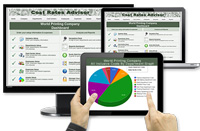
The Cost Rates Advisor is easy to use, software designed for the printing and packaging industry to take the mystery out of calculating budgeted hourly cost rates for your equipment. Determining your hourly cost rates no longer needs to be a difficult and time consuming task. The innovated design of the Cost Rates Advisor makes the entry of data simple with an easy to follow, straight-forward user interface.

You don't have to know accounting to calculate your budgeted hourly cost rates. Just enter your company data and calculate your hourly cost rates in minutes rather than days, no matter how big or small your company. It’s easy for anyone to use.

The Cost Rates Advisor was designed based on proven cost accounting principles, best practices, and standards used by industry leaders and experts.

The Cost Rates Advisor systematically compiles and distributes 100 percent of your expenses among each piece of production equipment so that all of your costs are accurately recovered in your estimates, pricing, and job costs.

It provides insight into exactly what makes up the cost of each department, cost center, and overhead. So you can stay informed of your true costs, keep track of your rates, stay competitive, and make greater profits.

Comprehensive Reports
The Cost Rates Advisor offers a variety of comprehensive, easy to read and understand reports that help ensure all your costs are accounted for in your cost rates. The budgeted hourly cost rates reports list the annual costs to operate each cost center including your direct manufacturing costs, direct labor costs, overhead costs, building and occupancy costs, all inclusive costs, and hourly cost rates based on various levels of productivity. You can display or print detail and summary reports that help you manage your costs rates including:


         • Deatail Budgeted Hourly Cost Rate Reports
         • Sales and Administration Costs Reports
         • Building Occupancy Cost Reports
         • Cost Center Cost Reports
         • Department Cost Reports
         • Employee Labor Cost Allocation Reports
         • Expense Allocation Reports
         • Asset Depreciation Cost Reports


Click Here To Learn More About Budgeted Hourly Cost Rates Software